Digital Workstation vs Traditional Eyepieces: Is EVOS Right for Your Lab?
When budgeting to buy a laboratory microscope, research facilities face a critical decision. Do you stick with the classic eyepiece layout found on a legacy Nikon Eclipse microscope, or transition to an all-in-one digital architecture like the Thermo Fisher EVOS series?
Choosing the right platform impacts your daily sample throughput, data accuracy, and spatial footprint. Below, we break down how these systems compare on metrics that matter to modern laboratories.
Image: Thermo Fisher Scientific EVOS M3000
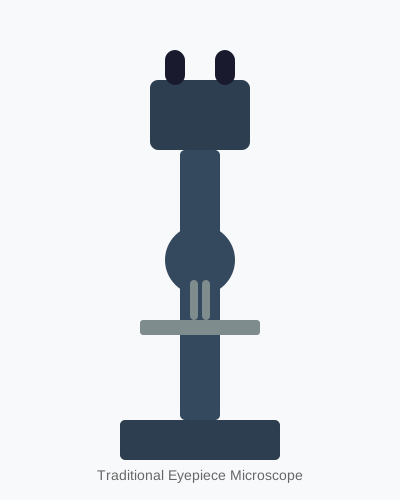
Traditional — Eyepiece Microscope
1. Ergonomics and Workspace Footprint
Traditional binocular lab microscopes or trinocular compound microscopes require users to spend hours hunched over eyepieces. This physical strain slows workflow speeds in busy core facilities.
EVOS Advantage: High-resolution LCD display screens allow multiple researchers to view live, high-contrast cellular samples simultaneously. Because the optics, digital camera, and software are integrated into a single sealed body, EVOS platforms easily fit inside standard biosafety tissue culture hoods — saving precious bench space.
2. Fluorescence and the Darkroom Problem
Traditional fluorescence microscopes for molecular biology generally need a dedicated darkroom to prevent ambient light from washing out signals. You also face ongoing tiers for mercury bulb replacements and optical realignments.
EVOS Advantage: Eliminates the darkroom entirely. Using patented LED light cubes and an integrated smart-shroud, you capture vibrant multi-channel fluorescent layers in brightly lit rooms.
3. Data Capture & Automated Analysis
With traditional frames, publication-ready data requires aftermarket digital cameras, external software calibration, and consistent settings between users.
EVOS Advantage: Built as a digital workstation from the ground up. Features like , Z-stacking, and time-lapse imaging are native functions controlled via touchscreen.
The Verdict: Which Should You Purchase?
| Choose Traditional If: | Choose EVOS If: |
|---|---|
| Primarily brightfield clinical histology | High-throughput cell assays |
| Materials science inspection | Live cell culture monitoring |
| Budget medical student microscope | Multi-channel fluorescence |
| Manual learning required | Maximize efficiency without alignment issues |
Recommended Models by Budget

EVOS M3000 (Entry-Level)
For educational institutions and core facilities needing standard classroom training and basic darkroom-free imaging.
Image: Thermo Fisher Scientific
See tiering →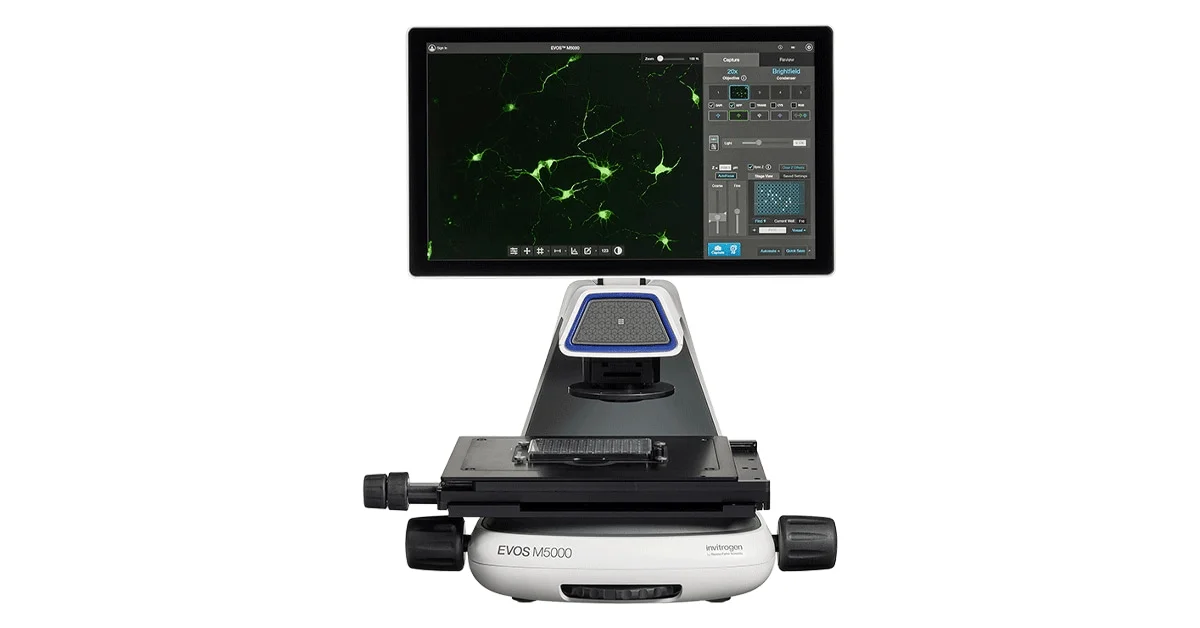
EVOS M5000 (Mid-Range)
For clinical labs needing routine cell monitoring, fluorescent viability checks, and tissue diagnostics.
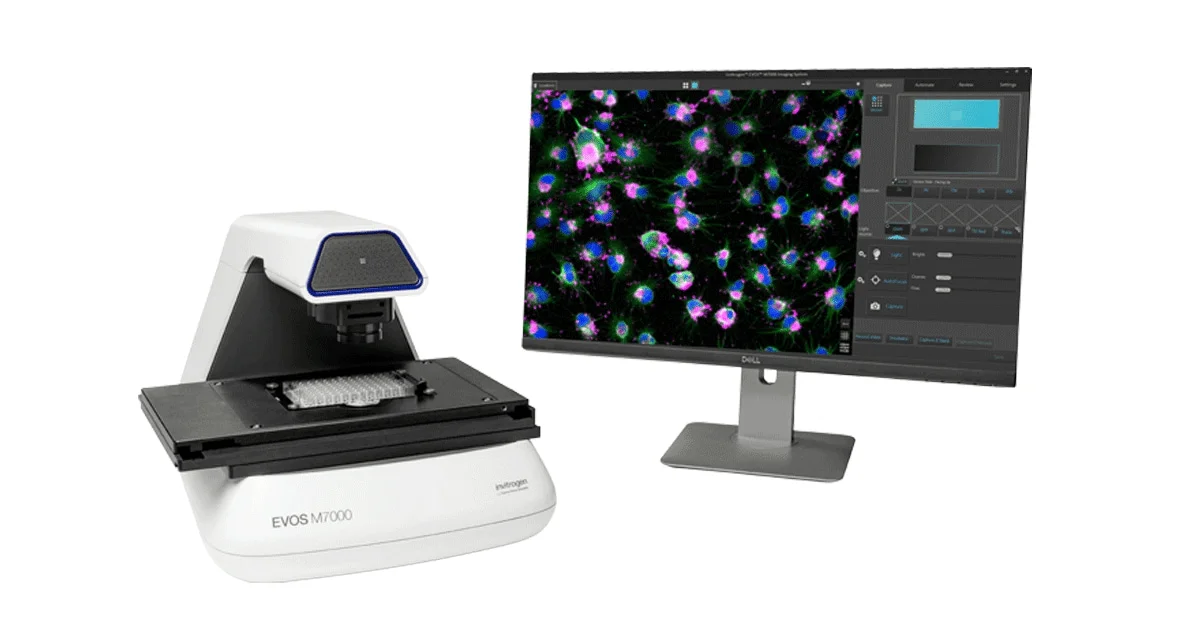
EVOS M7000 (Premium)
For university research labs running live-cell imaging, multi-channel fluorescence, 3D z-stacking, and time-lapse assays.
Image: Thermo Fisher Scientific
Read Full Review →Premium: EVOS M7000 (Fully Automated)
For university research labs running live-cell imaging, multi-channel fluorescence, 3D z-stacking, and time-lapse assays. Read our full EVOS M7000 review →
Mid-Range: EVOS M5000 (Advanced Manual/Semi-Automated)
For clinical labs needing routine cell monitoring, fluorescent viability checks, and tissue diagnostics.
Entry-Level: EVOS M3000
For educational institutions and core facilities needing standard classroom training and basic darkroom-free imaging. See tiering →
Next Steps
As UK microscopy resource, we help you find the exact fit for your budget. Explore our microscope buying guide or compare fluorescence microscopes in the UK.
Ready to Upgrade Your Lab?
Compare the EVOS M3000 against traditional systems in our detailed review.
Read EVOS M3000 Review