Image: Thermo Fisher Scientific
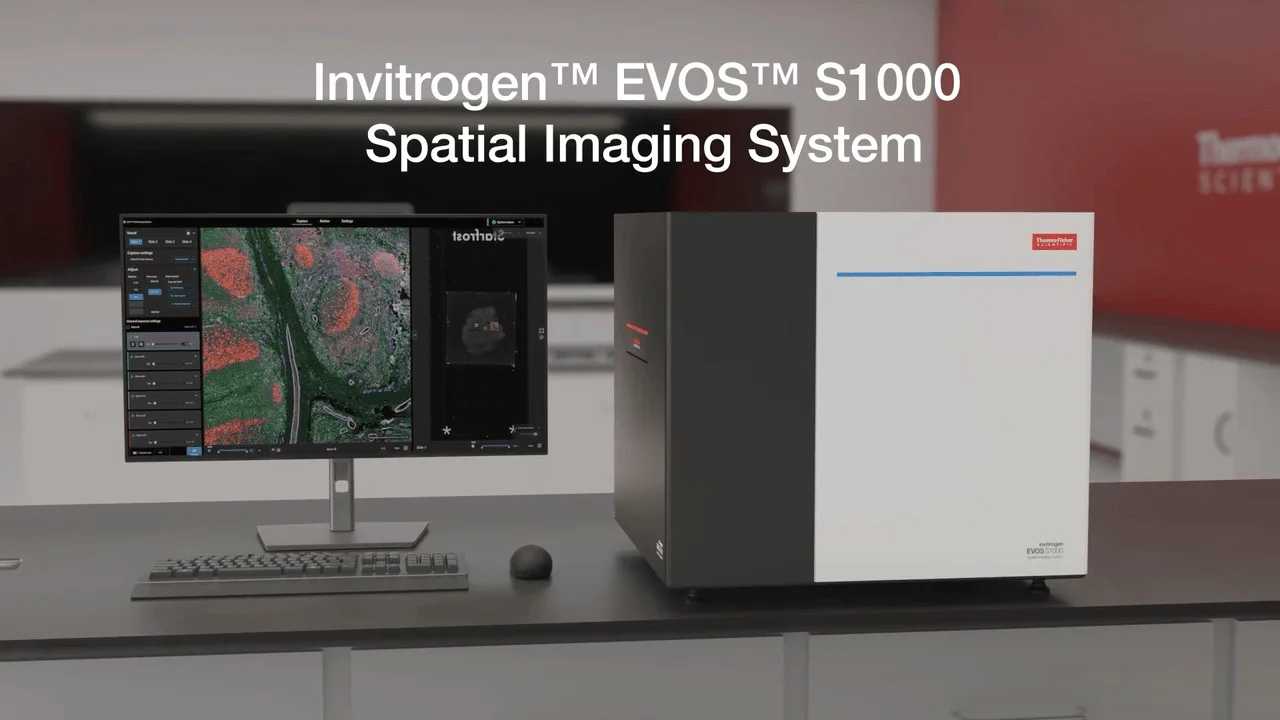
EVOS S1000 Spatial Imaging System
The EVOS S1000 is Thermo Fisher's dedicated spatial biology imaging platform, designed specifically for spatial transcriptomics, tissue imaging, and multi-region of interest (ROI) analysis. It bridges the gap between traditional fluorescence microscopy and advanced spatial omics workflows.
🔬 Key Features for Spatial Biology
- Large Field of View: Capture entire tissue sections in a single acquisition — critical for spatial transcriptomics where context matters
- Automated Multi-ROI Scanning: Program multiple regions across a slide for high-throughput spatial analysis
- LED Illumination: Stable, long-lasting light source with minimal heat — protects RNA integrity during imaging
- High-Resolution Optics: Resolves single-cell details within intact tissue architecture
- Integrated Software: Seamless workflow from image acquisition to spatial data export
🧬 Spatial Transcriptomics Integration
The S1000 integrates with leading spatial transcriptomics platforms:
- 10x Genomics Xenium: Pre-imaging tissue sections for ROI selection and quality assessment
- Vizgen MERFISH: Whole-slide imaging to guide multiplexed FISH experiments
- Custom Workflows: Export tiled images for integration with segmentation and analysis pipelines
📚 Key Publications & Research
🔬 Xia et al. — Science (2019)
"Spatial transcriptome profiling by MERFISH reveals subcellular RNA compartmentalization" — Foundational paper demonstrating multiplexed error-robust FISH for spatially resolved transcriptomics at single-cell resolution.
🔬 Moffitt et al. — PNAS (2016)
"RNA imaging. Multiplexed RNA imaging with MERFISH" — Early MERFISH protocol establishing the framework for high-throughput spatial transcriptomics imaging.
🔬 10x Genomics — Xenium Platform
Official Xenium documentation and publications. In situ gene expression analysis at subcellular resolution with targeted and whole-transcriptome panels.
🔬 Vizgen — MERFIS Hub
Publications, protocols, and application notes from Vizgen. Includes cancer microenvironment, neuroscience, and developmental biology case studies.
🔬 UK Biobank — Spatial Transcriptomics
UK Biobank's spatial transcriptomics initiative creating foundation models from diverse tissue types. Open-access data for researchers worldwide.
🔬 Oxford Spatial Biology
Oxford University research on clinical integration of spatial transcriptomics. Novel methods for tissue analysis and biomarker discovery.
🔬 Broad Institute — SpaceTx
Open-source spatial transcriptomics data standards and analysis tools from the Broad Institute. Starfish pipeline for image-based transcriptomics.
🔬 Nature Methods — Spatial Omics Collection
Curated collection of spatial omics methods papers from Nature Methods. Reviews, protocols, and technical comparisons.
📊 Specifications
| Feature | EVOS S1000 |
|---|---|
| Camera | High-resolution scientific CMOS |
| Objective Range | 4x to 100x oil immersion |
| Fluorescence Channels | 4-channel LED illumination |
| Stage | Automated XY with multi-point navigation |
| Imaging Modes | Brightfield, Phase Contrast, Fluorescence |
| Software | EVOS Capture + Analysis Suite |
| Data Export | TIFF, PNG, OME-TIFF, CSV metadata |