Which microscope and platform do UK labs need for the Cell Painting assay?
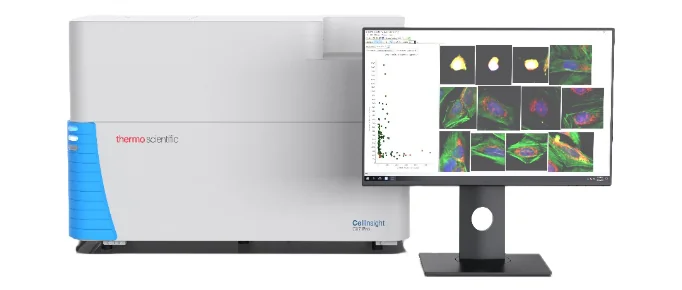
The Thermo Scientific CellInsight CX7 is the high-content screening platform UK labs use for Cell Painting. It captures all six Cell Painting dyes in a single automated run, then extracts thousands of morphological features for drug-discovery and toxicity profiling.
CellInsight CX7 LED Pro / LZR Pro — both models support widefield, confocal and brightfield imaging per Thermo Fisher specifications. Image: Thermo Fisher Scientific.
Cell Painting is a high-content imaging assay developed at the Broad Institute that uses six fluorescent dyes to paint different cellular compartments. By capturing multi-channel images and extracting thousands of morphological features, researchers create a "fingerprint" of cellular states that can reveal how cells respond to genetic or chemical perturbations.
By combining six stains into a single multiplexed assay, Cell Painting creates rich morphological profiles that can distinguish between different cellular states, drug mechanisms, and disease models. The resulting "cell fingerprint" is compared against reference libraries to predict mechanism of action, flag toxicity, or identify novel therapeutics. The assay is compatible with most modern high-content screening platforms and open-source analysis tools like CellProfiler.
Best Cell Painting Platforms: CellInsight CX7 and Alternatives
For Cell Painting in a UK screening lab, a dedicated high-content screening platform is usually the best fit. The CellInsight CX7 family combines widefield and confocal optics with either LED or laser excitation, a robotic plate handler, environmental control and Harmony/Signals analysis software. It captures all six Cell Painting dyes in one pass, with consistent field-of-view illumination across 96- and 384-well plates.
🔬 Inverted Microscopes
Ideal for cell culture work. Objectives sit below the stage, leaving the top of dishes and plates unobstructed. Essential for live cell imaging and automated screening on multiwell plates.
🤖 Automated HCS Platforms
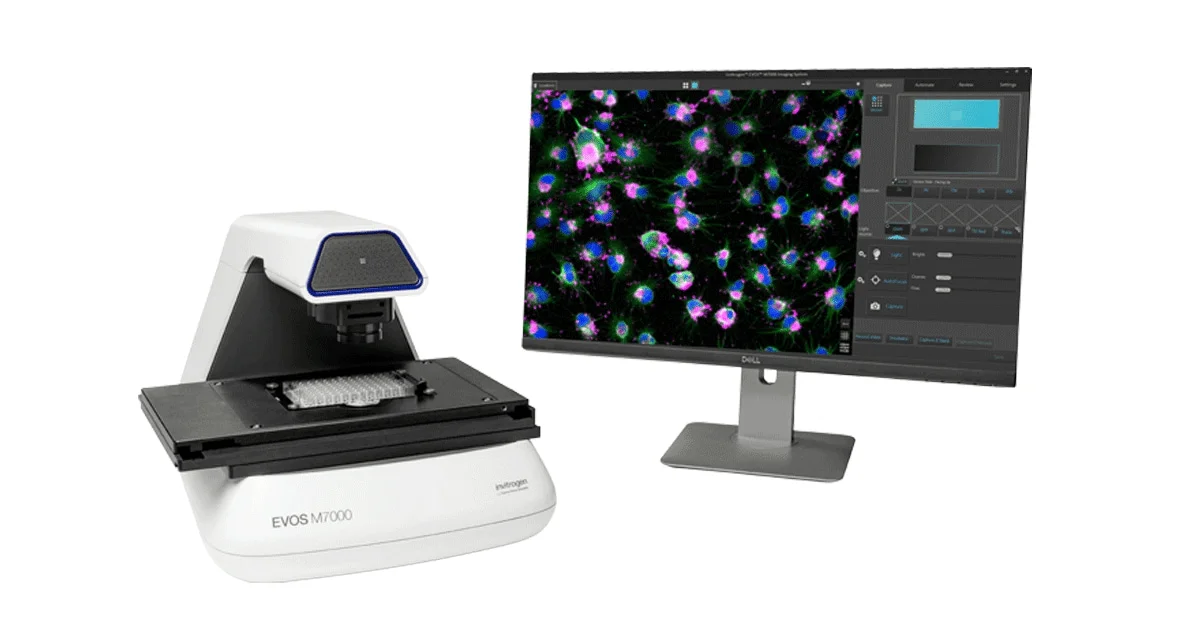
Systems like the Thermo EVOS M7000, CellInsight CX7, or ImageXpress offer integrated environmental control, autofocus, and robotic plate handling for high-throughput Cell Painting at scale.
Quick 4-Colour Overlay: EVOS M7000
For labs that need to inspect Cell Painting assays at the bench without a full HCS workflow, the Thermo EVOS M7000 gives an instant four-colour overlay on a large touch screen. It is a practical inverted fluorescence microscope for protocol development, troubleshooting, and teaching before moving plates to the CellInsight CX7.