EVOS M7000 Imaging System Review
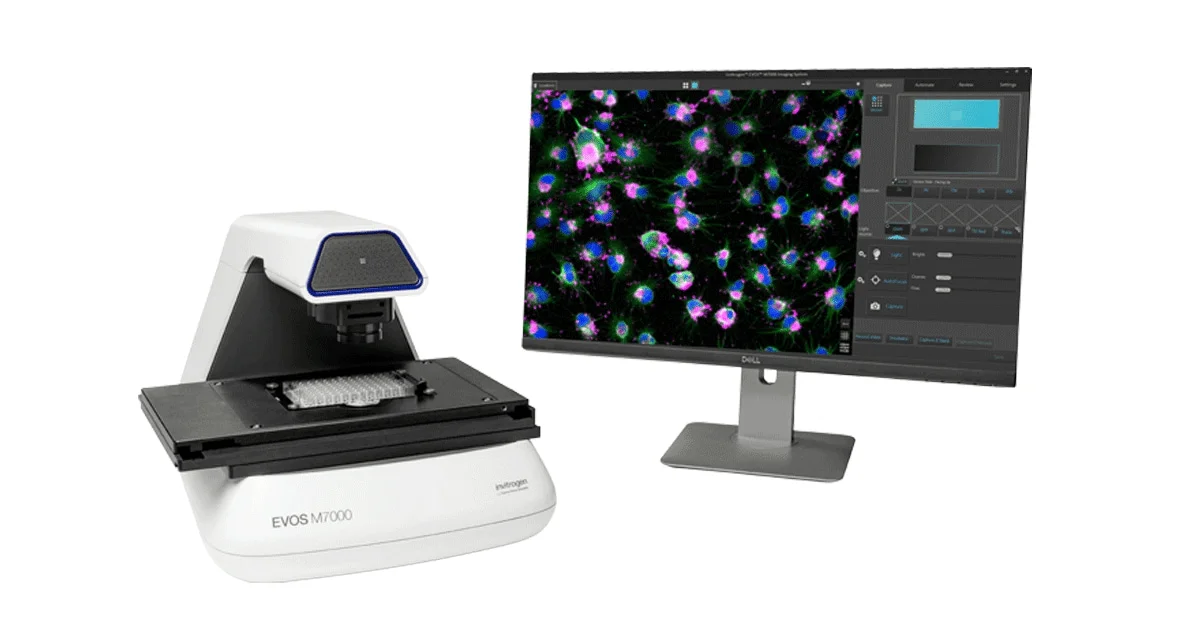
Image: Thermo Fisher Scientific
The EVOS M7000 is the premium-tier automated live-cell imaging and high-content analysis system for UK research laboratories that need plate-based workflows, quantitative assays and automated image analysis without the complexity of a confocal.
It keeps the LED fluorescence and biologist-friendly design of the EVOS family, but adds a PC workstation, automated stage control and Celleste™ analysis software. The result is a system that can scan 6- to 384-well plates, capture Z-stacks, run 2D/3D deconvolution, and export confluence, count and transfection-efficiency reports to Excel or CSV.
🎬 Watch: EVOS M7000 Analysis in Action
See automated confluence measurement and transfection efficiency analysis — 2 minutes from Thermo Fisher Scientific
Video: Thermo Fisher Scientific on YouTube
Key Features
- Automated Plate Scanning: Scan 6, 12, 24, 48, 96 and 384-well plates, plus slides and dishes, with multi-position workflows
- Z-Stacks and 2D/3D Deconvolution: Capture optical sections and computationally sharpen thick samples such as spheroids and organoids
- Live-Cell Time-Lapse: Incubator-compatible automation for long-term kinetic imaging
- Celleste™ Analysis Software: Automated confluence, cell counting, transfection efficiency and 3D measurements with CSV/Excel export
- Four-Colour Fluorescence: LED-based fluorescence, brightfield, phase contrast and colour imaging in one system
- Long Working Distance Objectives: 4x, 10x, 20x and 40x objectives suited to multi-well plates and plastic vessels
Specifications
| Feature | Specification |
|---|---|
| System type | Automated live-cell / high-content imaging system |
| Imaging modes | Brightfield, phase contrast, colour, 4-colour fluorescence |
| Display / control | External PC workstation |
| Camera | High-sensitivity CMOS for automated capture |
| Objectives | 4x, 10x, 20x, 40x long working distance options |
| Plate formats | 6, 12, 24, 48, 96, 384-well plates; slides; dishes |
| Z-stacking | Automated Z-stacks with 2D/3D deconvolution |
| Stage tracking | Multi-position plate scanning and revisit |
| Analysis software | Celleste™ analysis suite |
| Export formats | JPEG, TIFF, PNG, CSV, Excel reports |
| Light source | LED illumination with long lifetime |
Best For
- High-content screening and dose-response assays
- Drug discovery and toxicology groups running multi-well plates
- 3D cell culture, spheroid and organoid workflows
- Cell culture facilities needing automated confluence and transfection reporting
- Core imaging facilities supporting quantitative cell biology
EVOS M7000 Workflows
1. Automated Plate Scanning
The M7000 can map entire multi-well plates with minimal setup. Define a plate type, select fields per well, and the system moves between positions automatically. This removes the manual stage work of the M5000 and turns a 96-well readout from a 45-minute manual task into a short, unattended run.
2. Z-Stacks and 2D/3D Deconvolution
Z-stacking captures a series of optical sections through a thick sample, and 2D/3D deconvolution removes out-of-focus haze computationally. For organoids and spheroids up to ~200 µm, the M7000 can produce confocal-like sectioning without the light dose or premium cost of a laser-scanning system. A dedicated guide covers this in depth:
EVOS M7000 Z-Stack & 3D Deconvolution Guide →
3. Live-Cell Time-Lapse
The M7000 is incubator-compatible and can revisit the same wells over hours or days. This makes it suitable for kinetic assays such as proliferation, migration, wound healing and spheroid growth. Automated stage control means the same fields are re-imaged consistently, improving quantification across time points.
4. High-Content Analysis with Celleste Software
Celleste is the analysis engine behind the M7000. It turns raw images into quantitative readouts including confluence percentage, cell count, transfection efficiency and 3D object measurements. Results can be exported to CSV or Excel for downstream plotting. A detailed workflow guide is available:
EVOS M7000 Confluence & Transfection Analysis → Original blog deep-dive →
EVOS Family Comparison
Not sure whether the M7000 is the right EVOS for your lab? Compare the full EVOS line-up:
- EVOS M3000 review - entry-level fluorescence imaging
- EVOS M5000 review - Z-stacking, stage tracking and time-lapse
- EVOS M3000 vs M5000 vs M7000 UK 2026 - full three-way comparison of specs and use cases
EVOS M7000 in the Scientific Literature
The EVOS M7000 Imaging System is cited across a wide range of peer-reviewed studies. We have curated themed literature reviews covering cancer, cell biology, and infectious disease / neuroscience, plus a central research index linking to all roundups.
- EVOS M7000 in Cancer Research — oncology studies across proliferation, migration, invasion and cytotoxicity
- EVOS M7000 in Cell Biology Research — cell lines, stem cells, organoids and primary cultures
- EVOS M7000 in Infectious Disease and Neuroscience Research — virology, bacteriology and neurodegeneration assays
- EVOS M7000 / CellInsight CX7 Research Index — central directory to all curated M7000 and CX7 papers
- Real EVOS S1000 & EVOS M7000 Publications — actual peer-reviewed studies using EVOS hardware, with PubMed and DOI links
Where to Request a UK Demo or Quote
The EVOS M7000 is available in the UK through Thermo Fisher Scientific UK and authorised distributors. Because configurations vary with objectives, incubation chambers and Celleste software modules, UK labs should request a formal demonstration and official quotation from the manufacturer or an authorised distributor.
- Thermo Fisher Scientific UK (Official) - Product page and demo/quote request
- Fisher Scientific UK - Distribution and support
View Product on Thermo Fisher →
Frequently Asked Questions
What is the difference between the EVOS M7000 and M5000?
The M5000 is a professional all-in-one fluorescence microscope with Z-stacking, stage tracking and time-lapse, controlled via an integrated monitor. The M7000 adds a PC workstation, automated multi-well plate scanning and Celleste analysis software for high-content and quantitative assays.
Can the EVOS M7000 replace a confocal microscope?
For many cell-culture and multi-well applications, yes. The M7000's Z-stacks and 2D/3D deconvolution give confocal-like optical sectioning for samples up to ~200 µm with lower phototoxicity and faster capture. For very thick tissue sections or sub-200 nm super-resolution, a confocal or super-resolution system is still the better choice.
What plate formats does the EVOS M7000 support?
The M7000 supports 6, 12, 24, 48, 96 and 384-well plates, as well as slides and cell-culture dishes.
Does the M7000 include analysis software?
Yes. Celleste analysis software is the standard analysis suite for the M7000, with modules for confluence, cell counting, transfection efficiency and 3D measurements. Licence scope depends on the configuration, so confirm modules with the manufacturer when requesting a quote.
How do UK labs request an EVOS M7000 demonstration?
UK demonstrations and official quotes are arranged through Thermo Fisher Scientific UK or authorised distributors. Plankton & Zoom does not sell microscopes; use the manufacturer links above to request a demo.